
Reliable Dental Bridges in Raleigh, NC
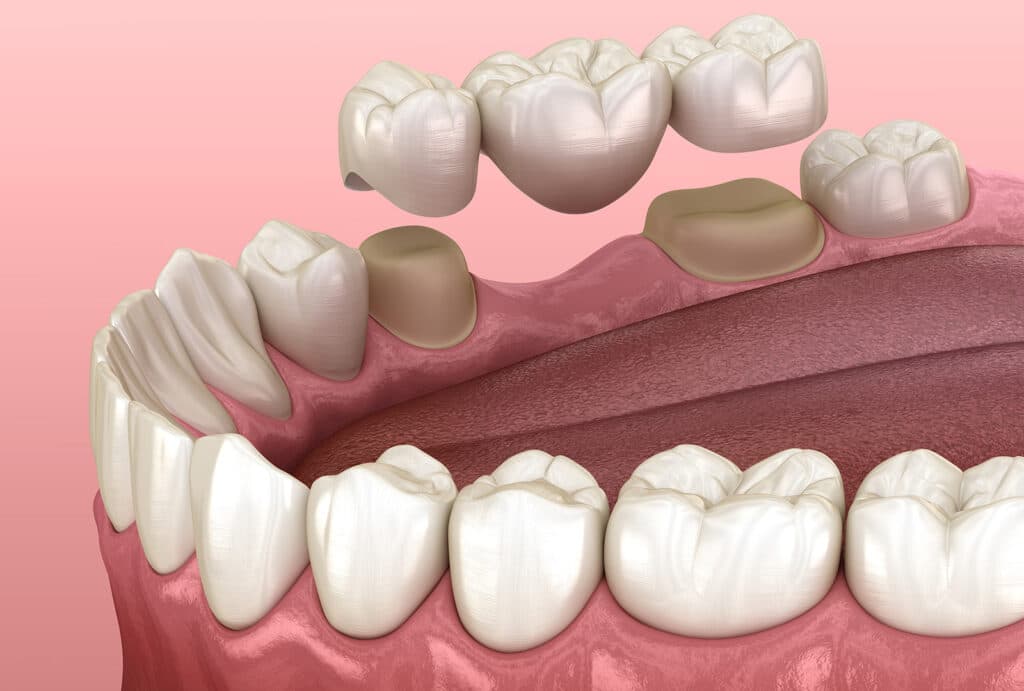
Do you need a permanent solution to your missing teeth? Dental bridges are good alternatives to partial dentures in replacing a lost tooth or a row of teeth, so you can eat, speak, and smile naturally. Woodall & McNeill offers reliable dental bridges in Raleigh, NC, and we have the information you need to decide whether you should get one.
What Are Dental Bridges?
As the name implies, dental bridges “bridge the gap” left by a missing tooth or a row of teeth. They can be made of porcelain, ceramics, resin, and metals like gold and cobalt. Ceramic is the material of choice for front tooth replacement. It can be tailored to your natural color and imitates the translucency of real teeth.
A dental bridge has two parts: the abutments (anchors) and the pontic (bridge). The abutments or anchors are dental crowns placed over your healthy teeth on either side of the gap. They support the pontic or bridge, a false tooth that fills the gap in your teeth.
The bridge can have one or two crowns and can be supported by one or two abutments, depending on your needs. Your dentist can have the dental bridges customized by technicians so they resemble your natural teeth.
What Are the Types of Dental Bridges?
If you decide to get a dental bridge after a consultation with your dentist, there are four types to choose from depending on your dental condition and desired aesthetics. Your dentist will consider your age, the number of teeth missing, the gap width, the state of your gums and teeth, and your preference, before recommending the kind of bridge you require.
- Traditional – The most common type of dental bridge and applicable if you have two healthy teeth on either side of the gap.
- Cantilever – This can be used if you only have one healthy tooth to support the bridge.
- Maryland – This dental bridge uses metal wings as abutments instead of crowns.
- Implant-supported – The most ideal solution for multiple missing teeth, it uses implants as abutments to support the pontic.
How long a dental bridge lasts depends on the type of dental bridge, but it usually ranges from 5 to 15 years.
Restore Your Missing Teeth With Dental Bridges
Dental bridges are a great way to restore missing teeth and natural smiles. You can get reliable dental bridges in Raleigh, NC, from Woodall & MacNeill by booking an appointment. Call us today to see if dental bridges are right for you.
Frequently Asked Questions about Dental Bridges in Raleigh, NC
Where can I get a dental bridge in Raleigh, NC?
Woodall & McNeill Dentistry provides dental bridges in Raleigh, NC, at 2020 Fairview Rd in the Five Points area near downtown. Dr. Dean Woodall and Dr. John McNeill place traditional, cantilever, Maryland, and implant-supported bridges based on which teeth are missing and the condition of the surrounding teeth. To book a consultation, call (919) 821-2595 or request an appointment.
Is a dental bridge better than a dental implant for a missing tooth?
Neither is universally better — the right choice depends on your bone health, the condition of the neighboring teeth, timeline, and cost. A dental implant replaces the tooth root as well as the crown, preserves the jawbone, and doesn’t require altering healthy adjacent teeth, but it takes 3 to 6 months to complete and needs enough bone to support it. A traditional bridge is faster (usually two to three weeks), doesn’t require surgery, and is a strong option when the teeth on either side of the gap already need crowns — but it does require filing down those neighboring teeth and doesn’t preserve bone under the missing tooth. Implant restoration is also available at the practice, so both options can be compared at your consultation.
How is a dental bridge different from a partial denture?
A dental bridge is fixed permanently in your mouth and functions like natural teeth — you don’t remove it to sleep or clean it. A partial denture is removable, held in place by clasps or attachments, and taken out daily for cleaning. Bridges generally feel more like natural teeth and are more stable for chewing, while partial dentures are less expensive, don’t require altering neighboring teeth, and can replace more teeth across multiple gaps in one appliance. Which one fits depends on how many teeth are missing, where they are, and the condition of the remaining teeth.
How many appointments does it take to get a dental bridge?
A traditional dental bridge typically takes two to three appointments over two to three weeks. At the first visit, the anchor teeth are shaped, impressions are taken, and a temporary bridge is placed. The permanent bridge is fabricated at a dental lab and cemented at the second visit, usually two weeks later. A follow-up may be scheduled to check the bite and fit. Implant-supported bridges take significantly longer — several months — because the implants need time to fuse with the jawbone before the bridge is placed on top.
Does getting a dental bridge hurt?
The procedure itself is not painful. Local anesthetic numbs the area before the anchor teeth are shaped, so most patients feel only pressure, not pain, during the appointment. Some mild soreness in the gums and jaw is common for a few days afterward and is usually well controlled with over-the-counter pain relievers. Temporary sensitivity to hot and cold at the anchor teeth also settles within a week or two once the permanent bridge is in place. Patients with dental anxiety can ask about nitrous oxide sedation to stay comfortable during the procedure.
How do I clean and floss a dental bridge?
Brush twice a day like normal, but you also need to clean under the false tooth where regular floss can’t reach. Use a floss threader or a product like Super Floss to slide floss beneath the bridge, or use a water flosser to flush out debris under the pontic. A soft-bristled interdental brush also works well for the space between the bridge and the gum. Skipping this step is the fastest way to shorten a bridge’s lifespan — decay under the anchor crowns or gum disease around the abutments is what usually causes bridges to fail early. Ask your hygienist for a demonstration at your next cleaning.
What can I eat with a dental bridge?
For the first 24 to 48 hours with a new permanent bridge, stick to softer foods while the cement fully sets and any soreness settles. After that, most foods are fine — most patients eat normally with a bridge, including meat, raw vegetables, and crusty bread. Long-term, avoid chewing ice, hard candy, or unpopped popcorn kernels on the bridge, and be cautious with sticky foods like caramel or taffy that can pull at the crowns. If a bridge is on your front teeth, biting directly into apples or corn on the cob is best avoided; cut them into pieces instead.
What happens if a dental bridge falls out or breaks?
Call your dentist right away — a loose or dislodged bridge is treatable but shouldn’t sit. If the bridge comes off cleanly and intact, keep it in a clean container and bring it to your appointment; in many cases it can be re-cemented if the underlying anchor teeth are still healthy. If it broke because a crown fractured or the anchor tooth developed decay, the bridge usually needs to be remade, and the anchor tooth may need additional treatment first. Avoid chewing on that side and don’t try to glue it back yourself with household adhesives, which can trap bacteria. Call (919) 821-2595 to be seen quickly.
Can a dental bridge be replaced when it wears out?
Yes. When a bridge reaches the end of its lifespan, typically 5 to 15 years, it can be replaced with a new bridge, or the treatment plan can shift to an implant-supported option if bone and gum conditions allow. Replacement is straightforward when the anchor teeth are still healthy: the old bridge is removed, the anchor crowns are reshaped or redone if needed, and a new bridge is fabricated the same way as the first. If an anchor tooth has developed decay, gum disease, or a crack in the meantime, that tooth is treated first (or extracted and replaced with an implant) before the new bridge is placed.
Are dental bridges safe if I have gum disease or diabetes?
Bridges can be placed safely with either condition, but active gum disease must be treated first, a bridge cemented over inflamed gums or unstable anchor teeth will fail early. Once gum disease is controlled through cleanings, scaling and root planing, and improved home care, the bridge process can proceed. Well-controlled diabetes doesn’t disqualify you from a bridge, though healing may be slightly slower and your dentist will coordinate with your physician if blood sugar is unstable. Bring a current medication list and recent A1C reading to your consultation so the plan reflects your full medical picture.